The former Gustavo Gili Publishing House: An icon of rationalism that embraces the technology of the future
Architecture lovers and enthusiasts will enjoy this year in Barcelona, as Barcelona has been officially designated UNESCO World Capital of Architecture 2026, a milestone that will place it at the international epicentre of urban planning and design, with the deployment of a wide range of activities in the 10 districts of the city. from mid-February to mid-December. In addition, Barcelona will also host the World Congress of the International Union of Architects (UIA), which will be held from June 28 to July 2, 2026. It's going to be an intense year.
Headquarters of this exciting global project: The former Gustavo Gili publishing house will serve as the headquarters for the Barcelona World Capital of Architecture project.
And, to begin with, it is worth visiting the headquarters of this stimulating global project: the building of the former Gustavo Gili publishing house, at 87-89 Rosselló Street, in the Eixample district. The publishing house, known for publishing books on architecture, design, art and photography, was born in 1902 by Gustavo Gili Roig, it consolidated itself as a reference publishing house in the field of visual culture, consolidating its catalog as fundamental for professionals in these disciplines.
A hidden treasure in the Eixample: Open spaces and natural light
A jewel of modern Catalan rationalist architecture, designed by Joaquim Gili and Francesc Bassó, built between 1954 and 1960, and awarded the FAD Architecture Prize in 1961, as indicated by the plaque next to the main entrance.
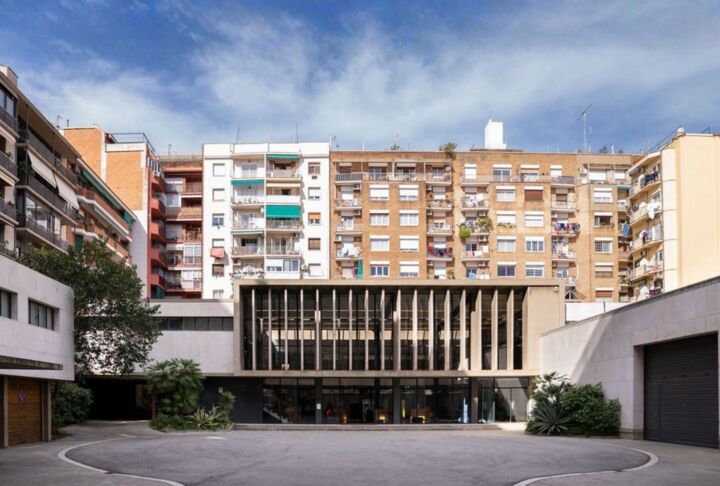
The emblematic building is a treasure little known by the general public, as it is somewhat hidden and protected, as it is located inside an island in l'Eixample del Pla Cerdà. It is accessed through a short passage that crosses a residential building quite in keeping with the aesthetics of the old publishing house; on the left, we see what was the caretaker's house; on the right, the entrance to the warehouse; and in the centre, the main façade of this jewel of modern Catalan rationalist architecture, the work of Joaquim Gili and Francesc Bassó, built between 1954 and 1960, and distinguished with the FAD Architecture Prize in 1961, as indicated by the plaque next to the main entrance.
It is a set of proportionate dimensions and technological rigour, the design is functional, sober and of a markedly industrial character: geometric volumes articulated through ventilation courtyards, green gardens and undulating shapes, with unique and very operational elements, few ornaments. The
unique rectangular concrete façade and the numerous openings that allow natural light to enter stand out. Inside, the architects created a very large open space, a few pillars in a "butterfly structure", a vault with a cantilever of up to 9 meters and glass still original.
In the lobby, which once housed the reception of the publishing house with an attractive counter and part of the offices, we can admire a large model printed entirely in 3D, an interactive platform and educational tool that allows us to analyse and explain the Barcelona of the past, present and future. We also enjoy a 5-minute audiovisual that gives us an overview of this World Capital of Architecture in Barcelona, and perfectly locates the 10 districts and their main venues. Behind the lobby, where the offices used to be, an exhibition now tells us how this impressive model was made and assembled, which required about 80 hours of assembly by specialized personnel.
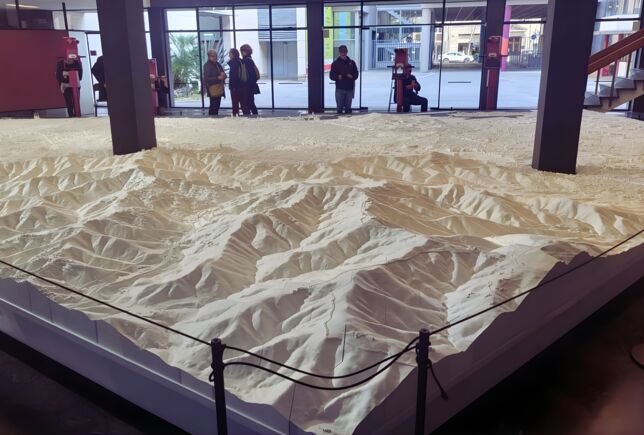
In this image, we can admire a large model printed entirely in 3D, an interactive platform and educational tool that allows us to analyse and explain Barcelona s past, present and future.
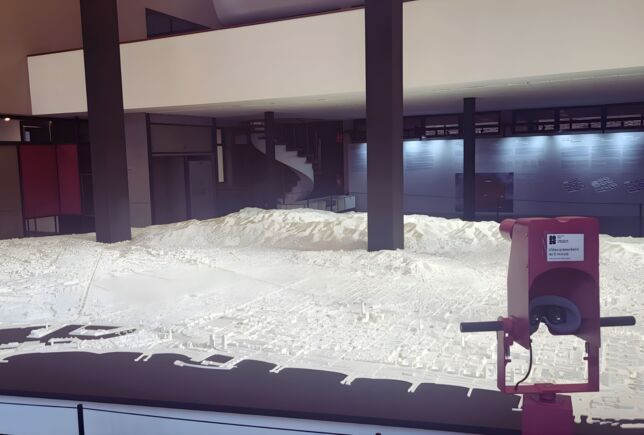
We also enjoy a five-minute video presentation that provides an overview of Barcelona s World Capital of Architecture, clearly identifying the ten districts and their main venues.
A trip to the 60s
The first floor is accessed via a straight staircase and a spiral staircase at the far end, next to which stands a huge safe the sort that no longer exists.
The building is flanked by blocks of flats that did not exist when it was built, which is why the surrounding green spaces have been reduced, although the courtyards have been preserved.
The first floor is accessed by stairs with rectilinear lines and a spiral staircase at the back, next to which a huge safe, of which no longer exists, is striking. The old boardroom and library is an elegant space, with a fireplace and all the walls covered to the ceiling with cherry-coloured wood, built-in shelves, now empty, once full of magnificent books. The room reminds us of our grandparents' house or our parents' house: the imagination flies and we evoke the past, it was the 60s. The rest of the first floor was used as offices and a rest area, while today it houses several rooms for exhibitions. The building is flanked by blocks of flats that did not exist when it was built, and that is why the surrounding green spaces have been reduced, although the courtyards have been maintained.
This work is an outstanding example of how modern architecture integrated workspaces and production into the dense urban fabric of mid-twentieth-century Barcelona. In a difficult time for progressive ideas in Spain, marked by the Franco dictatorship, the courage of Gustavo Gili, and the know-how of the architects Joaquim Gili and Francesc Bassó resulted in a pioneering building. The adoption of modern architecture as a movement of the contemporary era was thus vindicated.
The future: The House of Architecture
In 2016, the publisher moved its headquarters to Vía Layetana 47, also in Barcelona, and the building became the property of Amazon, until it was acquired by the Barcelona City Council in 2021. It was established as the headquarters of Manifesta 15 in 2024 and will be erected as the House of Architecture of Barcelona, a centre for exhibitions and relevant events for citizens.
Integrating GEZE innovation into architectural heritage
When looking at the rehabilitation of spaces of this relevance, it is impossible not to think about how GEZE solutions could enhance their current functionality as an exhibition and event centre. The transition from an industrial and administrative use to a public space requires technologies that respect the original aesthetics while ensuring maximum efficiency:
- Invisible and elegant accessibility: For a building with such clean lines, GEZE's automatic sliding glass door systems would allow a smooth entrance to the open-plan foyer without breaking the visual continuity of the concrete façade.
- Intelligent natural ventilation: Since the original building is articulated through ventilation courtyards and gardens, GEZE window automation systems would be ideal for managing air quality intelligently, optimising the energy efficiency of the centre.
- Safety and Evacuation (RWS): As the future House of Architecture, the safety of visitors is a priority. The implementation of access control systems and escape routes from GEZE would ensure discreet but foolproof protection, integrating into the "butterfly" structure and the spacious interior spaces.
With the support of cutting-edge technologies such as those offered by GEZE in safety and automation, pioneering buildings such as Gustavo Gili's can continue to fulfil their mission: to be living spaces where technical precision is put at the service of culture.
Visits: The building can be visited from Tuesday to Sunday from 10:00 a.m. to 7:00 p.m.
Location: Calle Rosselló 87-89, Barcelona.