La Lleialtat Santsenca: The heartbeat of a neighbourhood that embraces social architecture
The Lleialtat Santsenca is the headquarters of the Sants-Montjuïc district within the framework of the Barcelona World Capital of Architecture 2026 project. This is the largest district in Barcelona, made up of old municipalities outside the walls that grew with the construction of factories and working-class neighbourhoods during the 19th and 20th centuries.
The historic La Lleialtat Santsenca Workers' Cooperative, at 31 Carrer d'Olzinelles, was refurbished by Barcelona City Council and became in January 2018 a fantastic municipal community management facility, dedicated to the promotion of culture, neighbourhood and cooperation.
A haven of history and modernity in the heart of Sants-Montjuïc
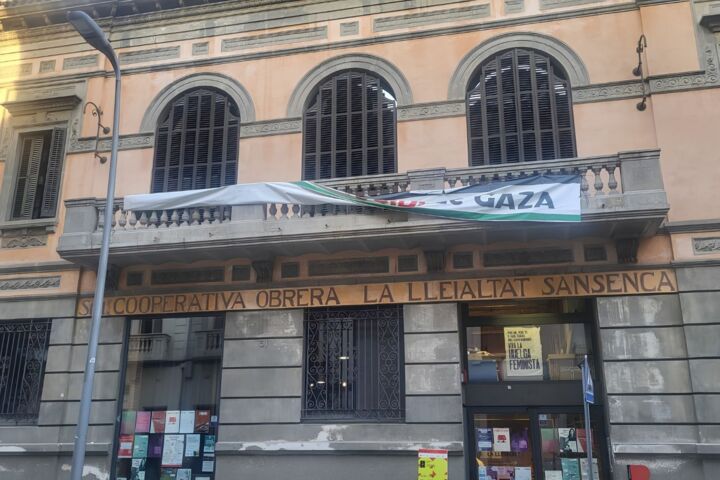
A view of the colourful posters on the main entrance door, which almost completely obscure the view of the interior.
The location of the building is discreet, it does not attract attention, if you are not attentive you even pass by. However, the sign painting on the austere façade, COOPERATIVA OBRERA La Lleialtat Santsenca, stands out, as well as the protest banner on the balcony of the first floor or the colorful posters on the main access door, which almost do not allow a glimpse of the interior, where various activities are announced and warn us that we are entering a climate refuge.
Upon entering the building, everything changes and curiosity grows as one advances, because the contrasts are spectacular and the transformation turned out to be very groundbreaking, although one of the objectives of the project was to respect and take advantage of everything that was usable, of some rooms classified as unhealthy in their day. It is a building of 2029 m2 of constructed area, distributed over 3 floors and a mezzanine floor. The project was awarded by public tender to the H-ARQUITECTES studio and was based on three premises: to understand the historical value of the old workers' cooperative of the Sants neighbourhood (1928); to accurately assess the physical state of the building to make the most of everything that could be recovered; and to be sensitive to the entire collaborative process that the neighbourhood organisations began in 2009 to restore it.
The Magic of Rehab: Breathing Contrasts
Views of the interior and the atrium, which illuminates the building s interior all year round thanks to the transparent cellular polycarbonate panels that cover it.
The building consists of three differentiable structural bodies: the main body, with a façade facing Olzinelles and Altafulla streets, which houses the two main rooms (old shop on the ground floor and assembly hall on the first floor); the central body, with access from Altafulla street; and the interior body, without access to the street, which geometrically forms an L with the other bodies. Known as the Atrium, this wide longitudinal space connects the three bodies and connects the two cores of stairs, as well as being the key to the sustainability of the project, which was a basic requirement of the rehabilitation.
For this reason, the Atrium was configured as a bioclimatized intermediate space capable of organizing all circulation through a series of walkways and stairs that evoke the image of a scaffolding. The building is thermally efficient thanks to passive strategies based on thermal mass and insulation; Three lightweight covers allow natural light to enter and facilitate ventilation. The larger volume of the roofs allows solar capture: in winter the Atrium absorbs the heat of the sun and the hot air expelled by the air-conditioned spaces through forced ventilation, and this heat is recovered by means of heat recovery; in summer, the air on the upper level of the Atrium overheats, generating a very powerful convection that expels the hot air through the ridge windows, which are operated by automatic sensors. Likewise, the Atrium illuminates the interior of the building throughout the year thanks to the transparent cellular polycarbonate panels that cover it.
A space with character and international awards
And as one climbs the stairs, floor by floor, one admires the originality of this very particular construction, the combination of ancient and modern materials, for example, is spectacular: the finishes of exposed and tochana work, stone, plaster contrast, both with the steel of the main structure, girders, beams, stairs and braces, as well as with the category of the wood cladding; a harmonious coexistence between the ancient and the modern. And, in addition, each plant is different. Thus, in the open-plan area on the ground floor, a group of neighbors are cooking and tasting typical dishes, while, in one of the rooms on the second floor, another group practices tai-chi.
The refurbishment of the Lleialtat Santsenca won the third Mapei Award for sustainable building 2020, the Shortlisted EU Mies Van der Rohe Award 2019, the European Award for Intervention in Architectural Heritage 2019, the Ciutat Barcelona Award 2017, and was a finalist in the FAD Awards 2018.
Technology and accessibility at the service of the community
An accessible, welcoming and intergenerational space that promotes, organises and presents activities and projects.
All in all, the new Lleialtat, managed by the Coordinadora d'Entitats per la Lleialtat Santsenca (CELS), is an accessible, close and intergenerational space that promotes, energizes and presents activities and projects, promotes social transformation, offers spaces to neighborhood groups and strengthens neighborhood and community life through participation, strengthening networks and creating complicities.
For an intergenerational space such as Lleialtat Santsenca to work, universal accessibility is non-negotiable. It is here that the vision of a human-centered architecture meets cutting-edge technological solutions.
Implementing GEZE solutions
In schools with a constant flow of neighbours – from children to the elderly – the integration of GEZE solutions is essential. The implementation of intelligent automatic doors and natural ventilation management systems allows historic buildings like this to not only retain their character, but also meet current standards for safety and energy efficiency. GEZE solutions make it easier for these infrastructures to be truly inclusive, removing physical barriers and bringing "invisible" technology to the indoor climate regulation of buildings.

